Sikaflex®-691
Multipurpose adhesive sealant

Sikaflex®-691 is a multipurpose adhesive sealant for bonding and sealing applications in the maritime industry. It is suitable for interior use and for exterior applications only on non-visible joints. Sikaflex®-691 is an elastic 1-component polyurethane adhesive sealant which cures on exposure to atmospheric moisture. It is based on Purform®, an industry-leading polyurethane with less than 0.1 % monomeric diisocyanate for better health protection and occupational safety.
- Fast & efficient workflow: Good adhesion to most substrates with minimal surface preparation
- Health-conscious formula: Less than 0.1 % monomeric diisocyanate and low emissions
- Versatile for interior & exterior (non-visible joints): Good aging and weathering resistance
- Above & below waterline: Suitable for below the waterline applications on boats
- Can be painted: For a seamless appearance and uniform look in visible areas e.g., cabins

Overview
PRODUCT BENEFITS
- Fast & efficient workflow: Good adhesion to most substrates with minimal surface preparation
- Health-conscious formula: Less than 0.1 % monomeric diisocyanate and low emissions
- Versatile for interior & exterior (non-visible joints): Good aging and weathering resistance
- Above & below waterline: Suitable for below the waterline applications on boats
- Can be painted: For a seamless appearance and uniform look in visible areas e.g., cabins
Areas of Application
Sikaflex®-691 is suitable with substrates commonly used in the marine industry. It generally bonds well to a wide variety of substrates like metals, timber, plastics, and paint coatings with minimal pre-treatment. Tests with actual substrates and conditions have to be performed ensuring adhesion and material compatibility.Packaging
| Cartridge | 300 ml |
| Unipack | 400 ml 600 ml |
Product Details
| Chemical base | 1-component polyurethane (Purform®) | |
| Color (CQP001-1) | White, grey, black | |
| Cure mechanism | Moisture-curing | |
| Density (uncured) | depending on color | 1.3 kg/l |
| Non-sag properties | Good | |
| Application temperature | ambient | 5 – 40 °C |
| Skin time (CQP019-1) | 45 minutes A | |
| Open time (CQP526-1) | 35 minutes A | |
| Curing speed (CQP049-1) | (see diagram) | |
| Shrinkage (CQP014-1) | 1 % | |
| Shore A hardness (CQP023-1 / ISO 48-4) | 35 | |
| Tensile strength (CQP036-1 / ISO 527) | 1.4 MPa | |
| Elongation at break (CQP036-1 / ISO 527) | 600 % | |
| Tear propagation resistance (CQP045-1 / ISO 34) | 7 N/mm | |
| Service temperature (CQP513-1) |
| -50 – 90 °C |
| Shelf life (CQP016-1) | 12 months B |
| CQP = Corporate Quality Procedure | A) 23 °C / 50 % r.h. | B) stored below 25 °C |
CURE MECHANISM
Sikaflex®-691 cures by reaction with atmospheric moisture. At low temperatures the water content of the air is generally lower and the curing reaction proceeds somewhat slower (see diagram 1).
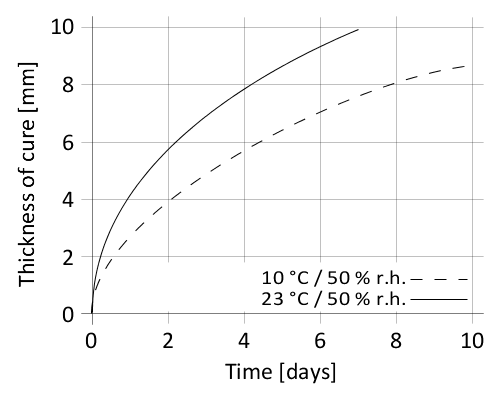
Diagram 1: Curing speed for Sikaflex®-691
CHEMICAL RESISTANCE
Sikaflex®-691 is generally resistant to fresh water, seawater, diluted acids and diluted caustic solutions; temporarily resistant to fuels, mineral oils, vegetable and animal fats and oils; not resistant to organic acids, glycolic alcohol, concentrated mineral acids and caustic solutions or solvents.
Application
Surface preparation
Surfaces must be clean, dry and free from grease, oil, dust and contaminants.
Surface treatment depends on the specific nature of the substrates and is crucial for a long lasting bond.
Suggestions for surface preparation may be found on the current edition of the appropriate Sika® Pre-Treatment Chart. Consider that these suggestions are based on experience and have in any case to be verified by tests on original substrates.
Application
Sikaflex®-691 can be processed between 5 °C and 40 °C (climate and product) but changes in reactivity and application properties have to be considered. The optimum temperature for substrate and process material is between 15 °C and 25 °C. Sikaflex®-691 can be processed with manual, pneumatic or electric driven piston guns.
Tooling and finishing
Tooling and finishing must be carried out within the skin time of the product. It is recommended using Sika® Tooling Agent N. Other finishing agents must be tested for suitability and compatibility prior the use.
Removal
Uncured Sikaflex®-691 may be removed from tools and equipment with Sika® Remover-208 or another suitable solvent. Once cured, the material can only be removed mechanically.
Hands and exposed skin have to be washed immediately using hand wipes such as Sika® Cleaner-350H or a suitable industrial hand cleaner and water.
Do not use solvents on skin.
Overpainting
Sikaflex®-691 can be painted after formation of a skin. If the paint requires a baking process, best performance is achieved by allowing the sealant to fully cure first. 1C-PUR and 2C-acrylic based paints are usually suitable. All paints have to be tested by carrying preliminary trials under manufacturing conditions.
The elasticity of paints is usually lower than that of sealants. This could lead to cracking of the paint in the joint area.
Application limits
Seek manufacturer’s advice and perform tests on original substrates before using Sikaflex®-691 on materials prone to stress cracking.